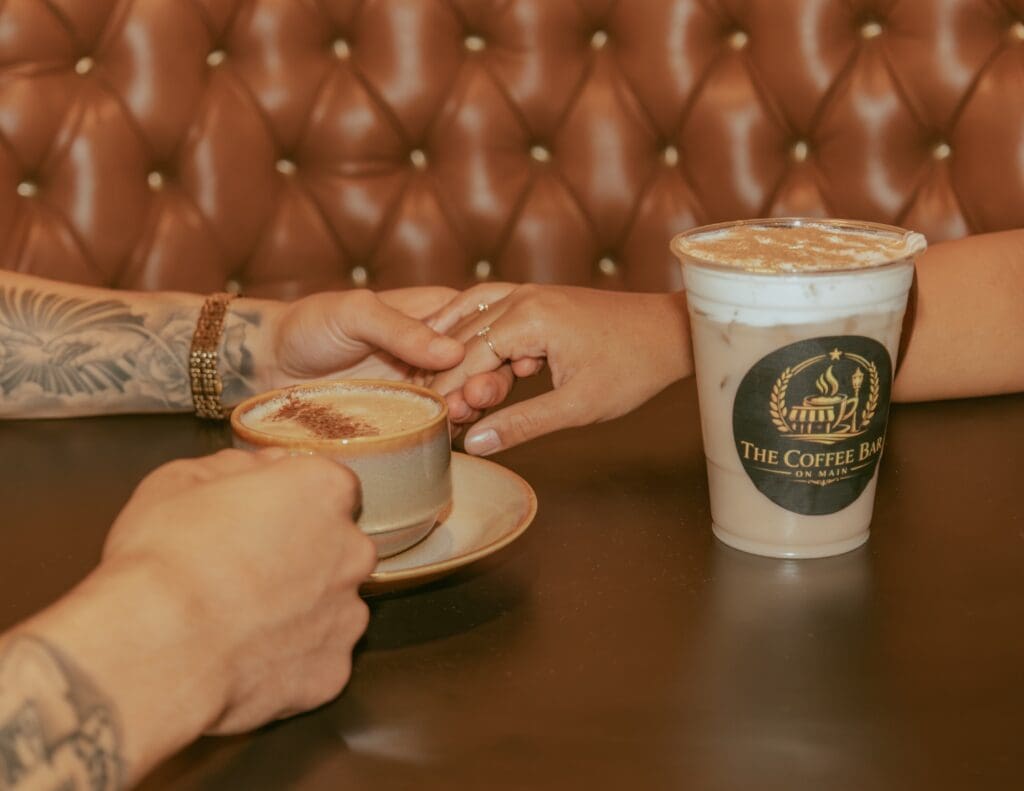
Most couples hire a photographer and then start figuring out where to stand.
That’s usually the order it goes in. You find someone whose work you like, you book a date, and then you open Pinterest and spend the next three weeks deciding between a canyon and a field. By the time the day shows up, the plan is a place. Nobody has really thought about what happens once you get there.
I’ll be straight with you. What happens once you get there is the whole thing. It’s the part that decides whether you actually like your photos or just tolerate them.
What a photoshoot feels like when the plan is only a location
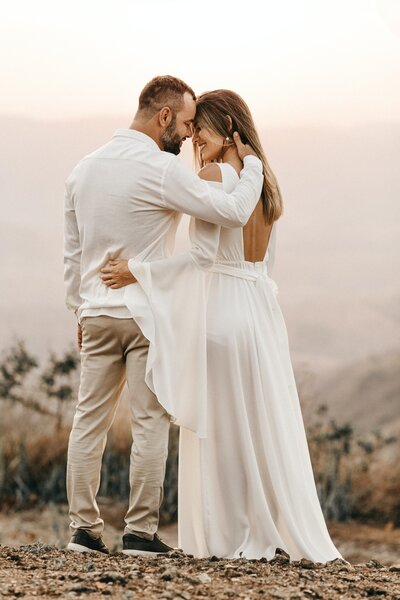
You show up somewhere pretty. You stand where you’re told. Someone you met twenty minutes ago asks you to put your forehead against your partner’s forehead and hold it. Then they ask you to laugh. You both do the laugh where you’re not really laughing. Your hands feel awkward. You have no idea what to do with them!
And then it’s quiet for a second, and the photographer says something like “just be natural,” which is the least useful sentence in the English language.
Nobody is doing anything wrong here. That’s what I want to be clear about. The couple isn’t awkward and the photographer isn’t bad at their job. The format is just asking people to perform being in love while standing still, and almost nobody is good at that. I wouldn’t be good at that.
So the photos come out fine. Pretty, even. They just look like a photoshoot, because that’s exactly what they were.
The swap: decide what you’re doing, then decide where
An activity based couples photoshoot flips the order. Instead of picking a location and hoping something happens there, you pick the thing you’ll be doing, and the location comes out of that.
That sounds small. It isn’t. It changes what the two of you are doing for the entire session, which changes everything that comes out of it.
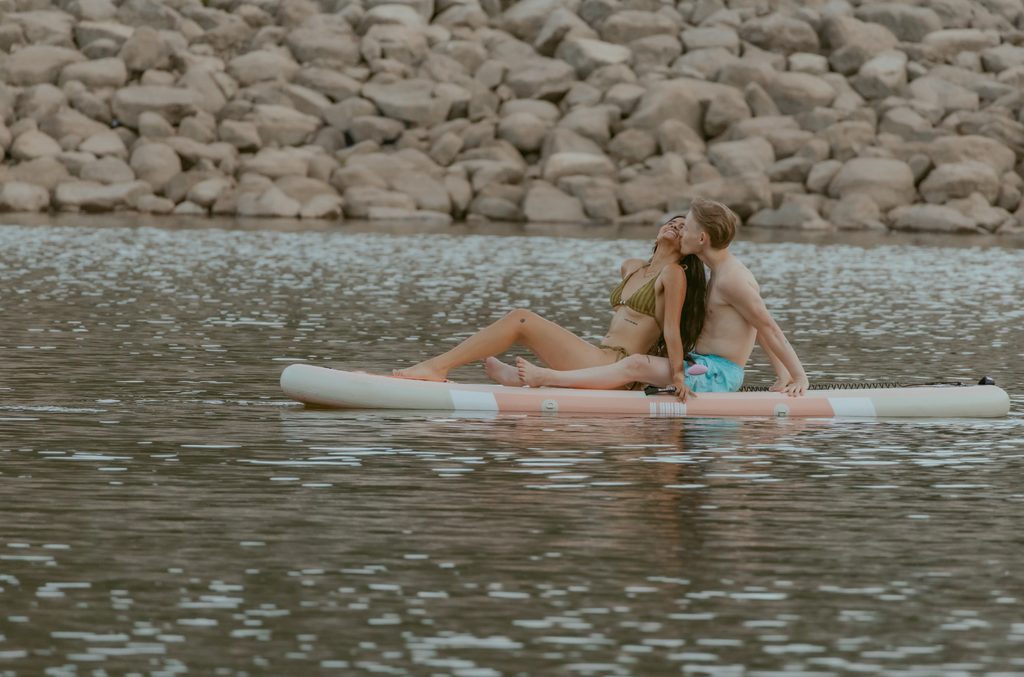
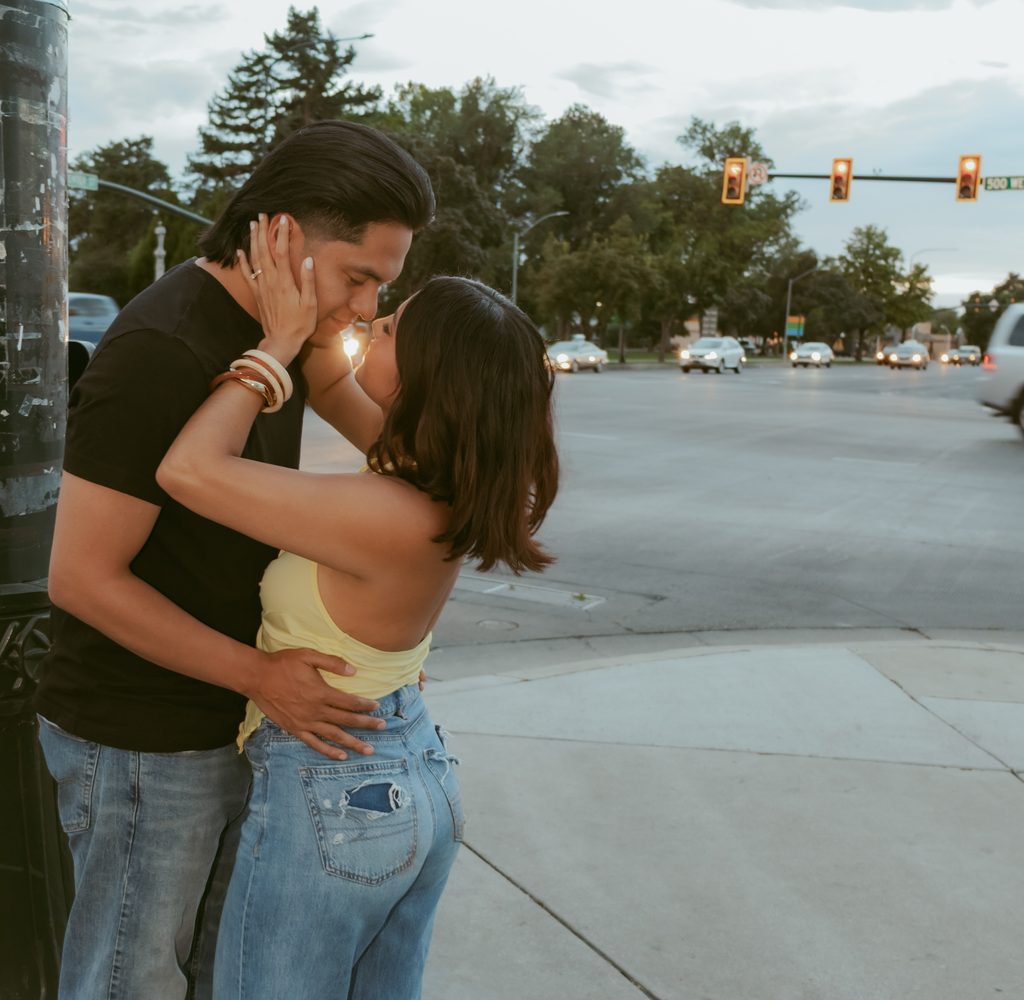
Here’s what I mean in practice. If you two go to the same coffee shop every Saturday morning, that’s a session. If you spend your summer on the lake, that’s a session. If you’ve been talking for a year about finally getting matching tattoos, that’s a session. I’ve shot all three of those. One couple walked me down the main street of the city they live in and just showed me their town, and it was one of my favorite sessions I’ve done.
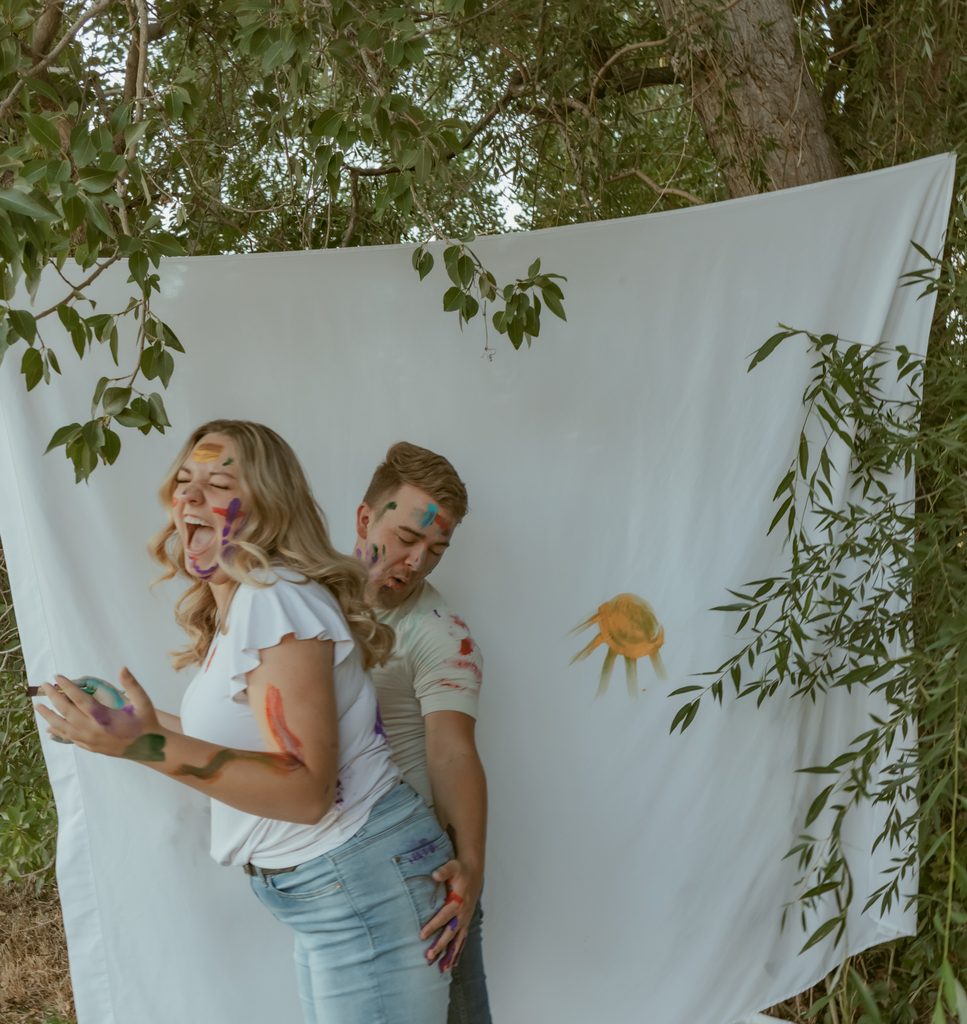
Another couple hung a white sheet between two trees, put on white shirts they didn’t mind ruining, and painted the sheet. Then they painted each other. I mostly just followed them around while it got messier. Nothing about that afternoon needed a single instruction from me.
None of those are expensive. None of them require you to be adventurous or outdoorsy or good at hiking. They just require you to be doing something.
What actually changes when you’re busy
Here’s the part most people don’t expect, and it’s the reason I built my whole approach around this.
When you two are doing something you like, you stop thinking about the camera. And you stop thinking about me. That second one matters more than the first. A camera is a piece of equipment, but I’m a person standing there, and the strangeness of being watched by a stranger is what most people are actually bracing for.
Give somebody a paddle, or a paintbrush, or a walk through a neighborhood they love, and their attention goes to that instead. They relax. They talk to each other instead of to me. A lot of the time they forget I’m there entirely, and that’s usually when I get the shot the whole session was for.
This is also my honest answer to the thing I hear most often before a session, which is some version of “we’re going to be so awkward.” I get told that constantly. And I’ll tell you what I tell them. I have almost never had a couple actually be awkward with me, and it isn’t because I’ve collected some unusually photogenic clientele. It’s that they’re never put in the position that makes people awkward in the first place.
I still guide. I’m not standing silently in a bush with a long lens. I’ll nudge you toward better light. I’ll ask you to do something again because a truck drove through the first one. I’ll tell you when something is working. But I’m guiding a thing that’s already happening instead of manufacturing one from scratch.
It doesn’t have to be something you already do
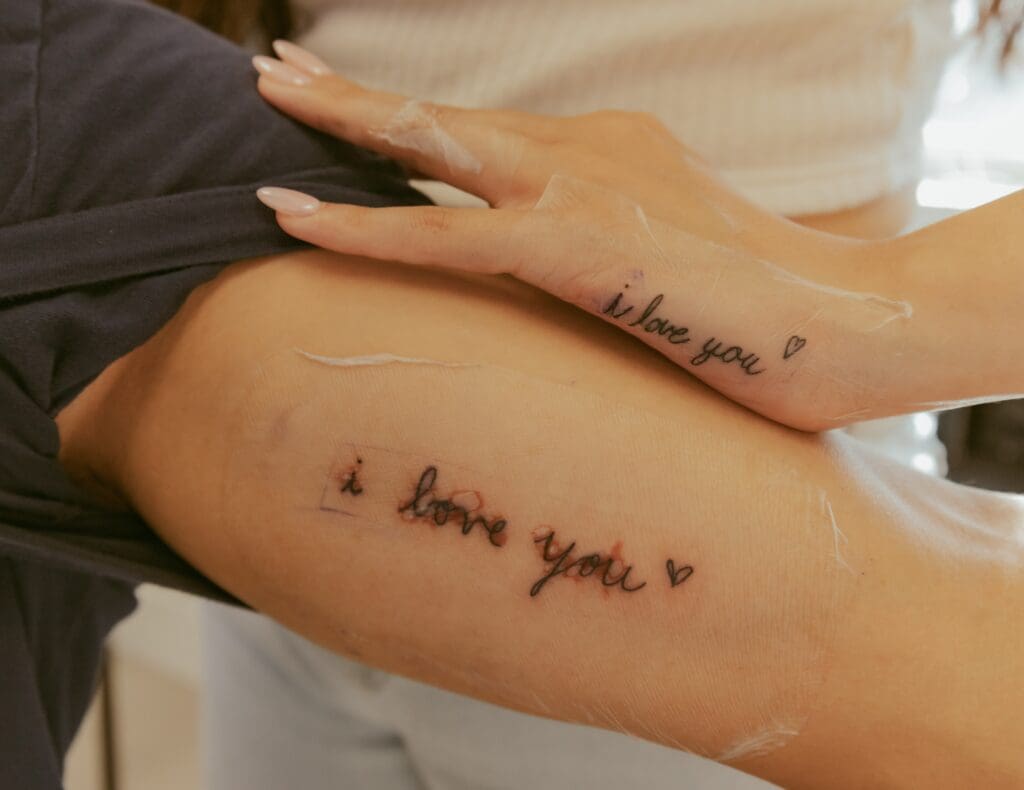
One thing worth saying, because it stops people: the activity doesn’t have to be a tradition. It doesn’t need history. It can be something you two have been meaning to try and never got around to.
Honestly, some of my favorite sessions come from that second category. There’s something specific that happens when two people try something for the first time together. Nobody’s good at it yet. There’s more laughing, more figuring it out, more looking at each other for confirmation. That’s a great afternoon to be photographing.
So if your first thought is “we don’t really do anything interesting,” that’s not disqualifying. It’s just a different question. Not what do you always do. What have you been saying you want to do.
Why the photos come out different
I want to be specific about what you actually end up with, because “candid” gets used so loosely that it’s stopped meaning much.
You end up with photos of things that are true. The way one of you tilts your head when the other one is talking. The particular face you make when you’re concentrating. Who reaches for whose hand first. The joke that neither of you would be able to explain to anyone else. Those are the things that make a picture of you two look like you two, instead of like a nice looking couple in a nice looking place.
You can’t pose those. I’ve watched people try. A posed version of a real habit always looks slightly off, the same way a photo of someone pretending to laugh looks nothing like a photo of someone laughing.
The other thing you get is a record of a specific season of your life, with the actual details in it. Your apartment. Your car. The coffee place before it closed. The haircut you had that year. In ten years those details will be the part you can’t believe you have.
How I handle it once we’re working together
Practically, this starts before anything gets booked. The first thing I ask is what you two actually like doing together. Not what would photograph well, and not where you want to go. What you like. I don’t bring up a single location until I know that, because the location is a downstream decision and I’d rather not anchor you to a place that fights the activity.
From there I work out the logistics that make the activity actually work on camera. What time of day the light is right for that specific thing. How long the activity really takes once you account for setup. Whether the spot allows what we’re planning to do, which matters more than people expect once you’re talking about a business or a park or a venue. Whether we need a backup for weather. That’s the part I handle so you two don’t have to think about it. It’s also most of what separates a session that flows from one that stalls out in the parking lot.
Then, on the day, my job is mostly to stay out of the way of the thing you came to do.
If this is the kind of session you want
If you’ve read this far and you’re already thinking about what you two would pick, that’s a good sign. That instinct is the whole starting point, and it’s a much better starting point than a location.
You don’t need a special occasion for this and you don’t need to be interesting on camera. You need one thing you two like doing, or one thing you’ve been meaning to try, and a couple of hours.
I’d love to hear what yours would be. Reach out and let’s talk through what your session could look like.






View comments
+ Leave a comment